A Close Look at CCBCs 2016 Data on Books By About American Indians First Nations
Eds. note: See AICLs list for 2016. On February 15, 2017, Cooperative Childrens Book Center (CCBC) at the University of Wisconsin released its statistics on the numbers of childrens books by/about American Indians/First Nations and People of Color during the year 2016. This is vitally important work that CCBC has been doing for many years. Two important things to know about these statistics (I am not critical of CCBC at all in noting these two things; doing some of this work myself, I know how very hard it is to do, to get books, and then to categorize/analyze them). The data is based on books that are sent to them. Small publishers generally cannot afford to send books out to review journals, bloggers, or centers like CCBC. That means books by small publishers who do great books by/about Native peoples may not be included in the data. It also means, however, that books by small publishers (or self published books) who do stereotypical books by Native people may not be included. The data is statistical. It is a count. It is not about the quality of the books on the list. To see what they recommend, see CCBC Choices. CCBC sent me the log of Native books for their 2016 counts. For the last few years I have been taking a close look at their log, focusing on fiction (as tagged by CCBC; books tagged as picture books are not included in this list) published by US publishers. Heres what I see. Note! Books in blue font are ones I recommend. Books in red font are ones I do not recommend. Books in bold are from "Big Five" publishers. Book in plain, black font are ones I have not read, with one exception (I have mixed feelings about Alexies book.) Fiction, US Publishers (books in bold are by one of the Big Five publishers) Heres the list of fiction written by Native people (N = 4):
Bruchac, Joseph. The Long Run. 7th Generation
Bruchac, Joseph. Talking Leaves. Dial/Penguin
Erdrich, Louise. Makoons. HarperCollins
Smelcer, John. Stealing Indians. Leapfrog Press (Note: Smelcers claim to Native identity is contested)
Now heres the books on the CCBC list, by writers who are not Native (N = 17):
Abbott, E. F. Mary Jemison: Native American Captive. Feiwel and Friends/Macmillan
Carson, Rae. Like a River Glorious. Greenwillow/HarperCollins
Flanagan, John. Brotherband: The Ghostface. Penguin
Heacox, Kim. Jimmy Bluefeather. Alaska Northwest Books
Hitchcock, Bonnie Sue. The Smell of Other Peoples Houses. Wendy Lamb/Penguin
Inglis, Lucy. Crow Mountain. Scholastic
Harrison, Margot. The Killer in Me. Hyperion/Hachette Book Group
Lewis, Ali. Timber Creek Station. Carolrhoda Lab
MacColl, Michaela. The Lost Ones. Calkins/Highlights
Mann, J. Albert. Scar: A Revolutionary War Tale. Calkins/Highlights
Massena, Ed. Wandmaker. Scholastic
Oppel, Kenneth. Every Hidden Thing. Simon and Schuster
Patel, Sonia. Rani Patel in Full Effect. Cinco Puntos Press
Reeve, Kirk. Sun Father Corn Mother. Sun Stone Press
Stokes, Jonathan. Addison Cooke and the Treasure of the Incas. Philomel/Penguin
Velasquez, Crystal. Circle of Lies (Hunters of Chaos, Bk 2). Aladdin/Simon and Schuster
Who publishes what? In 2016, the Big Five published two Native writers (Bruchac and Erdrich). Of those two, Ive read and recommend Makoons. Bruchacs book is out for review.
In 2016, the Big Five published eight non-Native writers (Abbott, Carson, Flanagan, Hitchcock, Harrison, Oppel, Stokes, and Velasquez). Of those eight, Ive read and do not recommend Carson, Hitchcock, and Harrison (not all reviews are online yet). I also do not recommend some of the non-Native books from small publishers: Flood, MacColl, Mann, Massena (not all reviews are online yet).
A comparison between 2015 and 2016
---------------------------------------------------2015--------------2016------- Books by Native writers............................3......................4............ Books by Non-Native writers....................7.....................17...........
From US publishers, there were 10 in 2015. For 2016, it is 21. That is a huge change, but it is due to non-Native writers. Of the 17, Ive read eight and found all of them lacking in some way. What will I find if I read the other nine? Based on experience, Im not optimistic. Ernie Cox, at Reading While White, reviewed Abbotts book about Mary Jemison. I trust his review. I think it would end up on my not recommended list.
Theres more to do, in terms of analyzing CCBCs data. Thats what Ive got, for now.
___________________________________
Update, Feb 23 2017, 10:20 AM -- back to list titles in fiction/Canada, and picture books in US and Canada.
Fiction, Canadian Publishers. (Note: none in either category are by Big Five publishers.)
Native Writers (N = 2):
Currie, Susan. The Mask That Sang. Second Story Press
McLay, R. K. The Rahtrum Chronicles. Fifth House
Non-Native Writers (N = 4)
Bass, Karen. The Hill. Pajama Press
Koner, Miriam. Yellow Dog. Red Deer Press
Ouriou, Susan. Nathan. Red Deer Press
Richardson, Eve. Saving Stevie. Red Deer Press
It is interesting that there are not any books from the Big Five. The Big Five are in Canada, too, with "Canada" tagged on.
For example, Robbie Robertsons Testimony is published by Knopf Canada, which is part of Penguin Random House Canada. It is non-fiction, by the way, and it isnt meant for children. It came out in 2016. My guess is that it wasnt sent to CCBC. Robertson is Native. Another example is Joseph Boydens Three Day Road. It is published by Penguin Canada. It came out in 2008, in the adult market, but is assigned to high school students. Boyden is not Native.
___________________________________
Picture books, US Publishers:
Native writers (N = 2):
Alexie, Sherman; illustrated by Yuji Morales. Thunder Boy Jr. Little Brown
Connally, Judy Shi, and Lawana Tomlinson Dansby; illustrated by Norma Howard. My Choctaw Roots. Choctaw Print Services.
Non-Native writers (N = 3)
Burton, Jeffrey; illustrated by Sanja Rescek. The Itsy Bitsy Pilgrim. Little Simon
Lai, Trevor. Tomo Explores the World.
Marshall, Linda Elovitz; illustrated by Elisa Chavarri. Rainbow Weaver = Tejedora del acoiris. Childrens Book Press/Lee & Low.
___________________________________
Picture books, Canadian Publishers (none in either category are by Big Five publishers) Native writers (N = 9)
Avingaq, Susan and Maren Vsetula; illustated by Charlene Chua. Fishing with Grandma. Inhabit Media
Baker, Darryl; illustrated by Qin Leng. Kamik Joins the Pack. Inhabit Media
Dupuis, Jenny Kay (and Kathy Kacer); illustrated by Gillian Newland. I Am Not A Number. Second Story Press
Highway, Tomson; illustrated by Julie Flett. Dragonfly Kites/Pimithaagansa. Fifth House
Kalluk, Celina; illustrated by Alexandria Neonakis. Sweetest Kulu. Inhabit Media
When I started my blog my intention was for it to be the dynamic update content partner to my static core content pages on my website. Then some posts started to be linked from external sites so to simplify click-throughs I decided to maintain them. That in itself became cumbersome when highlighting what had changed for return viewers. Now there is a problem with new comments not displaying on one of the blog postings so Ive decided to reorganize and return to a multi-media format approach for sharing my work.
My website (www.linuxium.com.au) will contain the latest and complete documentation of my development work. All download links will be current and provide the most recent versions.
My blog (www.linuxiumcomau.blogspot.com) will highlight new development work which has been updated to my website. Additionally each blog posting has a comment facility where discussions can occur.
My social media G+ (https://plus.google.com/+IanMORRISON), Facebook (https://www.facebook.com/Linuxium) and Twitter (https://twitter.com/linuxium) accounts will be updated each time I post on my blog and serve both as notification media and for those wishing to subscribe for updates.
Comments including praise, criticism and suggestions are welcome on all media. Requests can be emailed and technical issues should be reported as comments on the relevant blog posting. The best way to help when reporting a technical issue is to include the name of your device and a copy of the output from dmesg (which is basically a log of kernel messages). The easiest way to share the log is by using the pastebinit command (see https://help.ubuntu.com/community/Pastebinit). After installing the command by entering sudo apt install pastebinit you can share the kernel messages log by entering dmesg | pastebinit. This will paste a copy of the output from dmesg to Ubuntus Pastebin and provide an URL to access it. So when reporting a technical issue please include: - Outline of issue - Name of device - URL from pastebin (e.g. http://paste.ubuntu.com/23646692)
Finally I am totally dependent on donations to continue my work so a donation link (http://goo.gl/nXWSGf) rather than adverts is included on all sites. Please use this to donate.
A Close Look at CCBCs 2015 Data on Books By About American Indians First Nations
On February 23, the Cooperative Childrens Book Center at the University of Wisconsin released its statistics on the numbers of childrens books by/about American Indians/First Nations and People of Color during the year 2015. Their data is based on books that are sent to them. It is raw data that does not address the quality of the books themselves. This data is important and Im very glad they collect it. I use it in my work.
In 2015, CCBC estimates that they received about 3,400 books. Dr. Sarah Park Dahlen at St. Catherine University, working with illustrator David Huyck, Molly Beth Griffin, and several others (including me), created a graphic that depicts the CCBC data for 2015. Kudos to Sarah for getting it done. David Huycks idea--to reflect the percentages by different sized mirrors--is excellent. Including animals, trucks, etc., is also excellent because it tells us that there are more books about animals, trucks, etc. than about any individual demographic. Thats deeply troubling.
As of this writing (Thursday, September 15, 2016), the graphic has gone viral. It is being widely shared across social media. Im very glad to see that, but Im also seeing lots of assumptions about the data itself. My post today is a close look at the data specific to Native peoples and my attempt to look closely at that 0.9% on the graphic.
Earlier this year, CCBC sent me the list of books on their American Indian Log (it includes First Nations, Latin America, Pacific Islands, and New Zealand). There are a lot of ways to analyze their list. I may do more with the list in another post, but for now, Im focusing on fiction (according to CCBCs tags) published by US publishers.
Fiction, US publishers:
Heres the list of fiction written or illustrated by Native people (titles in blue are ones that AICL has recommended, here or elsewhere; titles in black have not been reviewed)
Bruchac, Joseph. Trail of the Dead. Published by Tu Books/Lee and Low (Apache)
Bruchac, Joseph. Walking Two Worlds. Published by 7th Generation (Iroquois)
Robertson, Robbie. Hiawatha and the Peacemaker. Published by Abrams Books for Young Readers. (Mohawk)
Now heres the books on the CCBC list, by writers and illustrators who are not Native (titles in red are ones that AICL reviewed here or elsewhere and did not recommend; titles in black have not been reviewed)
Bowman, Erin. Vengeance Road. Published by Houghton Mifflin Harcourt. (Apache)
Johnston, E. K. Prairie Fire. Published by Carolrhoda/Lerner. (Haida and Tseshaht)
Osborne, Mary Pope. Shadow of the Shark. Published by Random House. (Maya)
Rose, Caroline Starr. Blue Birds. Published by Penguin/Putnam. (Tribal nation not specified)
Shepherd, Megan. The Cage. Published by Balzer + Bray/HarperCollins. (Maori)
Velasquez, Crystal. Hunters of Chaos. Published by Aladdin/Simon and Schuster. (Mayan and Navajo)
Voelkel, J & P. The Jaguar Stones: The Lost City. Published by EgmontUSA. (Maya)
Who publishes what? In 2015, the Big Five publishers did not publish Native writers. Over half of the books the Big Five published misrepresent and/or stereotype Native peoples. As I found in the 2013 data set, Native writers get published by smaller publishers.
What does that mean? If teachers/librarians wanted to get all 11 of the fiction from US publishers on the 2015 CCBC list, theyd likely have a harder time getting those from the smaller publishers because those arent stocked in stores like ones from the major publishers. Given the poor quality in the books from the Big Five, children will most easily see problematic depictions of Native people.
Is there a focus on one Native people? Yes. There are 3 books with content specific to the Mayan people. I think thats interesting because this sample is US publishers. We might expect that, in sum, wed see them publishing books about US tribal nations, but, no! It is very hard to make generalizations based on such a tiny set of data, but what do you think?
What settings (chronologically) get published? There are 11 books. Some are straight up historical fiction (Blue Birds). Several, like Shadow of the Shark are hard to categorize because theres time travel. I think this sample is not large enough to make any definitive statements about setting, but what do you see? What observations might you make?
The bottom line:
The Native child in the new graphic is holding a very small mirror. When you take a close look at the quality of the books that could be mirroring her in some way, what she gets is, primarily, distortions.
_____ This post was updated on September 16 to correct an error. Patty Loews book was incorrectly listed in the CCBC log as fiction. It is nonfiction and has therefore been removed from the list of books by small publishers, above.
First of all , I am sorry for taking hiatus from blogging, I was having my End Semester examination and hence wasnt able to devote much time to Blogging. Anyway , couple of days back Cannonical came out with new release of Ubuntu, Ubuntu 9.04 "Jaunty Jackalope" and being ardent follower of Ubuntu, I decided to take a look at some of the exciting new features in Ubuntu 9.04.
Ubuntu 9.04 does not boast of ground breaking or earth shattering new features but instead tries to be as simple as possible. Infact , compared to previous releases of Ubuntu it might be one of the least radical release.Ubuntu 9.04 is more of an update to the earlier release of Ubuntu. Though , there have been some significant changes in Ubuntu 9.04 which I try highlighting here.
I tried installing Ubuntu 9.04 on my Intel 965GM graphic chipset based laptop , only to discover that I was getting awful frame rate while playing HD or even Sub-HD videos. After spending some time on Google and Ubuntu forums , I found few Intel chipsets were blacklisted in this release of Ubuntu and would only be fully supported in Update to Ubuntu 9.04, which was kind of sad :( . However, I found one solution (is bit nerdy and could make your system unstable) which seemed to have got Graphic performance of my system back to awesome again. If you own one of these chipset based graphic card , you might like to see this post.
Ubuntu 9.04 is extremely fast and entire desktop loads up in a jiffy , Infact entire boot process and loading up of desktop took less then 45 seconds on my cranky old laptop. Another , awesome change in Ubuntu 9.04 is the new sleek interface and brand new visual notification system.
The new visual notification system does away with any sort of interaction element like buttons, this way Cannonical has tried reducing the distraction caused by notification popups. The notification bubbles are more aesthetic looking and are translucent. Multiple notifications pile up below one another , and hovering mouse over notification makes it translucent.Notification disappears automatically after few seconds.
Ubuntu 9.04 also includes a number of community themes which were optional in Ubuntu 8.10.Ubuntu 9.04 also has improved support for multiple monitors.
New Wave - One of the new themes included in Ubuntu 9.04
Ubuntu , has a entireley new log in screen and is extremely simple yet sexy. Ubuntu 9.04 has removed Shutdown option from the System menu and instead the only way you can switch off , hibernate , logout , lock your system is by clicking on small power button at the top right corner of the screen. I found this bit annoying, I have been used to Shut down option in System menu for some time now. One thing which pissed me off was the new update notification dialog box , unlike earlier releases where you had update icon in the bar, If updates were available. In Ubuntu 9.04 , update dialog box pops up every now and then and forces you to update your system(which is good , but this frequent popping up of update dialog box is annoying! ).
On technical side, Ubuntu 9.04 includes ext4 file-system which has support for extremely large files and is extremely fast, ext4 also allows you to defrag your drive which many Windows users might relate to. Though , ext4 is not enabled by default and you have to chose ext4 manually during partitioning.
Installation , has also been simplified with extremely user friendly time zone selector, which basically splits entire world map into different time zones and lets you chose your time zone graphically.
New Time Zone Selector :)
Ubuntu 9.04 includes OpenOffice 3.0.1 as Office Suite unlike Ubuntu 8.10 which carried older 2.x version of OpenOffice, Gnome 2.26 as desktop environment , Mozilla Firefox 3.0.9 and Kernel 2.6.28. Ubuntu 9.04 also to be future safe includes support for Cloud Computing.
Brasero - CD/DVD Burning tool
Ubuntu 9.04 has Brasero as its default CD burning application , it also provides backend functionality to nautilus for burning CDs.
Conclusion : In conclusion I am not going to claim that Ubuntu is going to beat Windows on desktop or we will see hordes of people jumping onto Linux bandwagon, but instead with Ubuntu 9.04 Cannonical has made Ubuntu 9.04 simple yet functional and I sincerely beleive simplicity is what is going to make people adopt Linux! Ubuntu is definately on right course and given proper oppurtunity(in forms of OEM adopting it) we will definitely see more and more people chosing Ubuntu as their primary desktop operating system.
Article Written by : Ambuj Varshney (blogambuj@gmail.com) For Linux on Desktop Blog , http://linuxondesktop.blogspot.com (C) 2009 , Ambuj Varshney
Apparently Japanese gaming mag Famitsu had two full page of information regarding the upcoming Gundam Xbox 360 game, Mobile Ops: The One Year War, and it looks awsome. Im hoping that being able to actually run around with these huge mechs will inspire the same kind of awe that I got while playing Shadow of the Colossus. With the exception of being able to control this huge beasts or do some serious damage. Is that too much to ask?
A Look at Final Fantasy XVs Latest 1 05 Update and Booster Pack Mini Review
Final Fantasy XV is a gift that keeps on giving and is really doing its best to keep everyone playing, whether its those who purchased it or those who bought the Season Pass holders like myself. This is a smart move considering the time between each of the upcoming character Episode DLCs and is a good way to stop the open world becoming stale and keep those still totally addicted like myself from becoming less addicted or worse, not playing at all. Normally I wouldnt write anything about an update to a game, but the 1.05 update added some really significant updates, such as timed quests and a higher level cap. On top of that, Season Pass holders also got the Booster Pack+ a day after the update so as a happy Final Fantasy XV fan, I wanted to give my thoughts on each new feature added to the game because some of them are pretty cool.
(Feel free to watch the video version!) Update 1.05
The new update to Final Fantasy XV adds some significant features and is available freely to anyone who owns the game. An exciting thing for those who own a PS4 Pro is probably the new Lite Mode that has a maximum of 60FPS and probably looks absolutely stunning. I dont own a PS4 Pro so I cant comment on this much, but it gives me a reason to be a little more jealous of everyone who does.
Also something I cant comment on much is the raised level cap as my characters are only just at level 80 as I write this (note: as I edit this, Ive hit level 100 woo!), but Im pretty excited for this. Usually levels are capped at level 99 in Final Fantasy games, but Final Fantasy XV players can enjoy getting up to level 120, which is a really cool change. I recently maxed out my characters skills and have missed having a goal to work towards, so its nice to know I can enjoy seeing my EXP go up for awhile. Also Im keen to have some totally OP characters for when I go verse a certain boss for a certain gold trophy and an curious to see if it will affect my enjoyment of XV. I do wonder if level cap increases will be a trend with future Final Fantasy XV updates, but even if its a one-off, its pretty damn cool.
The thing that had me most keen for the 1.05 update is the addition of Timed Quests. Ive written about how Im totally addicted to running around in Final Fantasy XVs world and Timed Quests are a great way to keep this interesting. The first one is pretty rewarding, with the current fun and challenging cactaur quest giving 10,000 EXP, 333 AP and 150,000 Gil upon first completion, plus cactaurs being 1000 EXP each anyway add up to a fantastic way to reach that new Level 120. This update is guaranteed to keep me checking back for those awesome rewards and I cant wait for more quests and hunts.
The last few updates are minor updates, but nonetheless help enrich the player experience in Final Fantasy XV. In case you were getting sick of hearing the Chocobo theme (is that possible?) while riding Chocobos, you can finally listen to the Audio Player while riding and if you wanted to listen to two tracks from NieR�s gorgeous soundtrack, you can do that now too. Prompto can also store 50 more photos (200 in total), which is nice since I havent been able to save new photos for awhile. The new update also takes out the Moogle Chocobo Carnival, which I�d already used to help me get my Fishing Skill to full and done pretty much everything in. The Chocobo music player and photo capacity probably shouldve been in XV already and are kind of insignificant at this point, but Ill take them and enjoy them anyway. All of these additions make a pretty solid upgrade to the base experience of XV and have already given me more reasons to keep playing.
Booster Pack+
The exclusive to Season Pass holders Booster Pack+ is a small little pack of items to mostly make fishing a little easier. The lack of a �wow� item in this pack is probably due to the delay of the Magitek Exosuit that is getting a redesign due to similarities to the Power Rangers� suits and was supposed to offer invisibility and a boost in fishing skills for a limited time. But the items are a nice little token for those with the season pass regardless. The Dragon Drain Rod and Avior Reel will be helpful for those upping their fishing skill; I dont overly care for these since mine is at max and I only really fished for new recipes and trophies. What I am enjoying is the Ragnarok sword, which packs a punch in battle and mostly just looks cool when warping due to it spitting a bunch of pink electrical looking stuff everywhere. It isnt however stronger than the Blood Sword I was using, so I may retire it soon, making the Booster Pack+ of little use to me.
Being honest, the Booster Pack+ is a tad lacklustre and is absolutely not worth getting the Season Pass for. But its an alright bonus for those like myself who have it already for the story episodes and if I ever decide to complete Noct�s fishing collection, Im sure Ill be at least a little happy I have it.
The real standout of these two additions to Final Fantasy XV is the free 1.05 update, but both it and the Booster Pack+ add nice little touches to enhance the current Final Fantasy XV. I enjoyed driving to the latest timed-quest while listening to music from NieR, and will be eagerly waiting for future timed-quests. Final Fantasy XV has been lucky to be getting so much support so far and I hope the addition of timed-quests among the other additions is a nod towards Final Fantasy XV getting support between each of its story episodes.
You can pick up Final Fantasy XV for Playstation 4 and Xbox One at Play-Asia.com
(This is an affiliate link that helps supports my JRPG Jungle content, so if you use it, thank you!)
What did you think of the Update and Booster Pack+? Are you still playing Final Fantasy XV? (I sure am...but I may need to take a break for NieR Automata :|) Leave a comment below, send me a tweet at @JRPGJungle, hit me up on Facebook, Youtube or Instagram and lets talk!
Thanks so much for stopping by! Make sure to follow the blog here, follow @JRPGJungle on Twitter and Instagram, like JRPG Jungle on Facebook and Subscribe to the mailing list and Youtube Channel for updates on content and random musings on JRPG news and games. Youre awesome! <3
The fact that webdetails joined pentaho doesnt mean well stop doing work on the Ctools. Much on the contrary, not only were doing more work than before, were also in a better position to do that work in a more aligned way to the main Pentaho roadmap.
As many of you know, Pentaho 5.0 is almost out, and comes with a different look and feel. And to start building some coherency, we changed CDEs look and feel.
This is just a start; In the backend, lots of stuff is happening / being planned to try to improve the ctools feature-wise. But its an amazing step!
Its already available in the dev branch, and will make its way into stable. Please report any issues you find.
Thanks to the UX and dev team for pulling this one out!
Ubuntu is one of the most popular desktop Linux distribution and a few days back Beta version of its new upcoming Ubuntu 8.04 was released . Being such a huge Ubuntu fan i decided to give it a try now after spending almost 14 hours downloading the isos on slow internet connection of the university i am studying in I was finally able to review the latest of the Ubuntu distro scheduled to be released on 24th April.
The first thing that you notice after booting the Ubuntu 8.04 beta CD is that now no longer you have to boot the entire CD into Live Graphical mode to install . Now there is an option in the opening grub menu that allows you to install Ubuntu 8.04 without loading the entire desktop .However one thing i disliked about this installation procedure was that it is still graphical , yes graphical installation simplifies things but there are old computers lying around(with less than say 512 megabytes of RAM ) and its difficult to install Ubuntu using the graphical method on such PCs without having swap drive . Ubuntu Team might consider including a Text based installer too .
Opening Boot Screen of Ubuntu 8.04
Graphical Installer
Another significant addition to the installation process is inclusion of the windows based installer Wubi that allows easy installation of the Ubuntu on your Windows based desktop . Its a standalone graphical installer that installs entire Ubuntu desktop as a single file-image on your Windows drive without any need of partitioning or resizing of your existing partitions . Now this is a really welcome addition to the installation process because partitioning is one of the most difficult step of installation (which carries a risk of removing your entire data) so by eliminating that step ,Ubuntu team has made the entire installation process a lot more user friendly for people who are using Windows and want to try Ubuntu .
Wubi Installing Ubuntu 8.04 Inside Windows XP on my frnz PC
Now once the installation is over and you boot into your newly installed Ubuntu system , the thing that strikes you at first if you had been using the previous version of Ubuntu is updated theme and Wallpaper . Ubuntu 8.04 has a new theme based on the old Human theme and powered by the Murrine engine . The wallpaper features "The Heron" itself and the Login Manager has been updated too .
Updated Login Manager
New Wallpaper featuring " Heron"
Architecture wise Ubuntu 8.04 includes X.org 7.3 which adds the long demanded feature of dynamic resolution changing (Means you dont need to restart Xserver after changing resolution ). Ubuntu 8.04 also includes Pulseaudio sound server which is advanced sound playing architecture allowing things like per-application sound settings, transferring the audio to a different machine, changing the sample format or channel count and mixing several sounds into one it does so by acting as proxy for your sound applications. It allows you to do advanced operations on your sound data as it passes between your application and your hardware.
Ubuntu 8.04 includes a crash reporting tool that sends information about the crash to the Ubuntus Launchpad(You would be seeing this a lot in beta version , the beta version i tested crashed a lot ) .All the earlier Ubuntu version were lacking a proper System Monitor and Ubuntu 8.04 does its bit of addressing this problem by inclusion of a really impressive System Monitor Application .
World View Applet
Ubuntu 8.04 comes with Gnome 2.22 and has a number of interesting features and additions including the new World View applet :) .
System Monitor Application
There have been security improvements, including better memory protection and a fine-grained access control system called PolicyKit.
Software wise there are number of interesting additions .
Firefox 3 Beta 4 is included with Ubuntu 8.04 Beta and Firefox 3 would most probably be included with the final release of Ubuntu 8.04 .
Ubuntu 8.04 Beta comes with Brasero for CD/DVD burning . It is a neat application with simple looks allowing one to burn CD/DVD easily , however you might like to install a more mature and hmmm User Friendly DVD/CD burning tool like k3b .
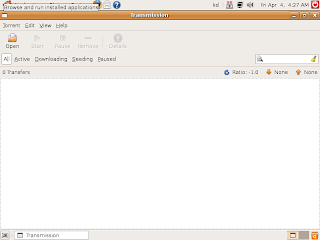
Also included is Transmission which is a very popular BitTorrent client and
// Inkspace a vector graphics editing tool has PDF graphics editing support .
Firefox 3 Beta -- Hmmm this list with name and address bar sucks seriously
Changes in Ubuntu 8.04 includes :
Inclusion of Gnome 2.22
X.org 7.3
Linux kernel 2.6.24-12.13
Pulseaudio
Policykit
Firefox 3 Beta 4
New apps like Transmission , Inkspace , Brasero etc
Brand new firewall
Conclusion : Ubuntu 8.04 Beta promises a lot and is shaping up to be a interesting update .The most important change/addition in 8.04 is simplification of installation procedure with inclusion of tool like Wubi making installation of Ubuntu on Windows based systems really easy. Firefox 3 and Brasero are welcome addition to Ubuntu . Also Ubuntu 8.04 seems pretty nippier and faster compared to the earlier releases . In short Ubuntu 8.04 is turning out to be an update worth waiting for .
Article Written by : Ambuj Varshney (blogambuj@gmail.com) For Linux on Desktop , http://linuxondesktop.blogspot.com (C) 2008 , Ambuj Varshney
If Nintendo was going for the less is more look for their box art for their Wii games, I would say they succeeded. I like it and I think it works pretty well. Its not all big and flashy and all "look at me, Im a Wii game!!".
Kia Provo Concept First Look SHOW FLOOR UPDATE: Upon hearing the name of Kias latest concept, "Provo." My first thought was Utah and then all the glorious cursing in the hit Broadway play, Book of Mormon. Kia Provo Concept Side Then I saw the vehicle roll out on stage and was immediately taken back to the 2012 Chicago Auto Show and the Kia Trackster debut. Like the Trackster, the Provo is a two-door hatchback, with low roof, Mini-esque proportions and similar white body/red roof paint scheme. The are some differences, including some radical triangular LED headlights that can pulse in animated patterns. The inside is even more stunning; awash quilted leather with a steam-punkish push button ignition/gear selector knob that looks straight out Guy Ritcheys Sherlock Holmes movie seeries. Developed in Kias European design center, the Provo is supposed to provoke, not only with its racing inspired elements, but with its possible hardware, including a hybrid AWD system and 7-speed dual clutch.
Kia Provo Concept First Look
Kia Provo Concept First Look
Kia Provo Concept First Look
Kia Provo Concept First Look
Kia Provo Concept First Look
So, is Provo thought provoking or curse invoking? - Edward Loh Rising from its former position as maker of cheap, disposable cars, Kia has infiltrated nearly every automotive segment over the past decade. Now that it has shown it can build competent everyday cars, and even entry-luxury models, Kia appears to be getting ready to enter the stylish compact hatchback segment that largely belongs to Mini. Introduced at the Geneva Motor Show, the Kia Provo concept demonstrates how the Koreans could take on the German-owned English brand. Kia Provo Concept Front End The Kia Provo’s exterior is highlighted by a steep rear window and abbreviated roofline that produce the appearance of a coupe. Its contrasting roof, frameless windows, and swept-back wraparound windshield instantly recall the look of the Mini Coupe -- which is probably no accident. The stubby nose bears a version of Kias tiger-nose grille hidden behind a glass panel; triangular housings hold headlights composed of 850 individual LEDs that can be configured to act as running lights, low- and high-beam headlights, and even animated displays. Below is a black mesh grille with orange-accented carbon-fiber surrounds. Where the angled rear windshield creates an acute angle with sheetmetal, full-width taillights reprise the same rectangle-and-triangles shape as the headlights and front grille. Two large round exhaust tips peek out from the lower fascia, while and adjustable diffuser panel hides below. Measuring 152.8 inches long and 69.7 inches wide, the Kia Provo is within spitting distance of a Mini Coupe, which is 147.0 inches long and 66.3 inches wide. More important, the concept cars stated purpose makes it clear that Kia wants a slice of the automotive pie that Mini so enjoys. Designed in Frankfurt, Germany, for the European market, Kia Europe chief designer Gregory Guillaume says the Provo is "aimed at delivering pure fun and performance for todays city-based enthusiast driver." Powering the Provo is the 1.6-liter turbo-four seen in the Hyundai Veloster, packing 201 hp. It drives the front wheels (19-inch alloys shod in low-profile tires) through a seven-speed dual-clutch transmission. In addition, a mild hybrid system that operates on the rear wheels can provide up to 44 hp of extra push under acceleration. Alternatively, pushing a button can allow the Provo to drive solely on electrical power for short distances. Kia Provo Concept Headight After opening the doors by way of pop-up handles, drivers enjoy a cabin composed of carbon fiber and aluminum. The former material is used for the inner door panels and dashboard, with real aluminum is used for the cars toggle switches and door handles. Red LEDs in the doors, air vents, and roof provide ambient lighting. The instrument cluster is a configurable LCD screen that by default shows a speedometer, tachometer, and navigation directions. Switching to cruise mode means the display shows only a large navigation map and speedometer, while the track option results in a giant tachometer, a lap timer, and a track map. An aluminum bracket atop the center console is home to a red engine start-stop button, a swiveling transmission selector, and a joystick to control the infotainment system. The Provos quilted-leather seats are, unusually, fixed in place, and instead the steering wheel and pedals adjust electrically. The seatbacks swivel out of the way, rather than folding, to permit access to the rear seats -- although Kia admits they are cramped and for "occasional-use" only. Kia says that the Provo concept is only meant as a show car for now, but its clear the company wants to explore the performance, premium, B-segment market. Hinting that it is "committed" to delivering cars just like the Provo concept, Kia will probably try to launch a vehicle that looks something like this Provo concept within the next few years.







.jpg)
.jpg)
